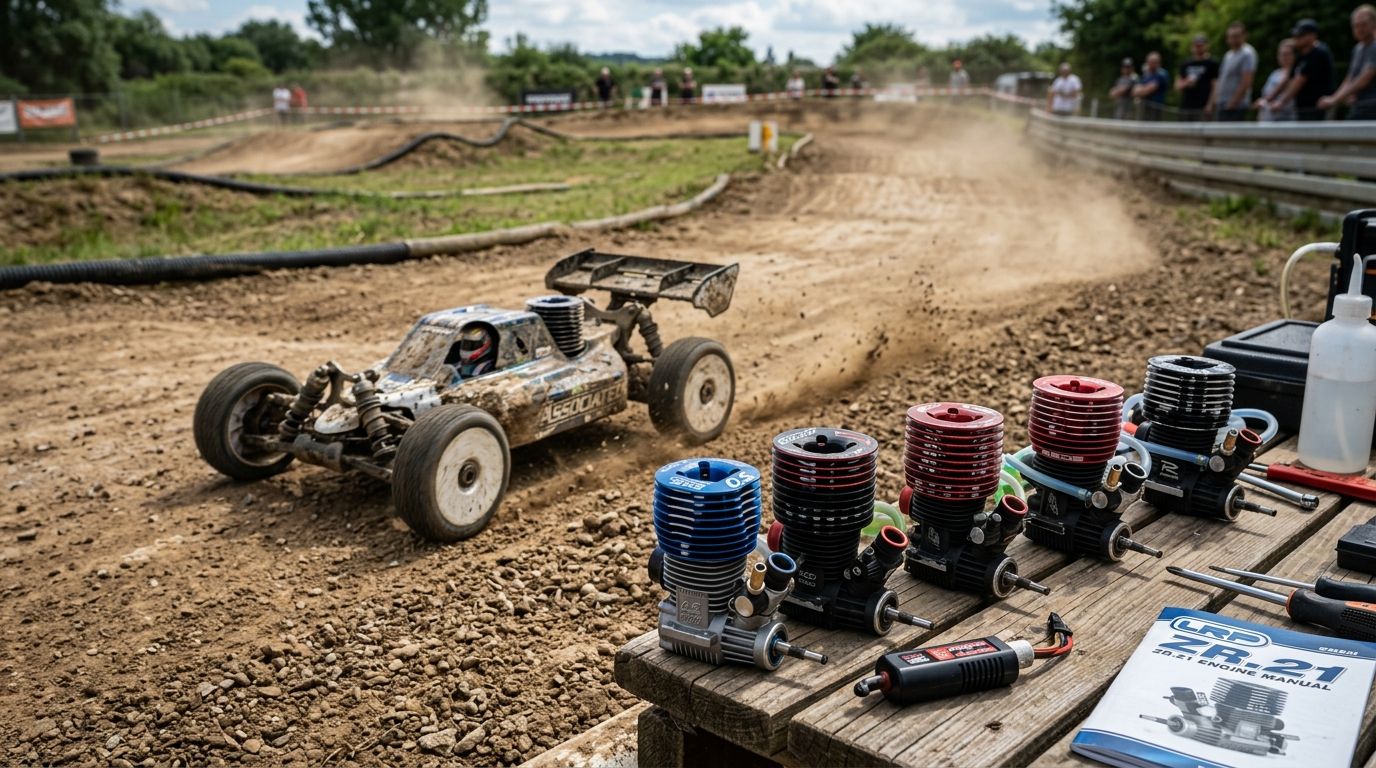
Off-road nitro buggy engines all live in the same displacement class, but piston-to-sleeve fit, carburetor stability under dust load, and how forgiving the break-in window is separate the engines that hold a tune from the ones that need constant needle chasing. This guide ranks five .21-class engines by the use case each one actually wins, not by hype.
- Novarossi Plus 21 SS is the best overall nitro RC engine for off-road buggies in 2026 for racers who want proven parts support.
- REDS R5R Gen3 wins for national-level competition where RPM ceiling and consistent compression behavior matter most.
- O.S. Speed R2104 suits club racers who want predictable break-in behavior with less tuning drama.
- Werks B7R is the pick for US-based buyers who want fast parts sourcing without importing.
- Picco P3 is the budget-conscious entry point for drivers moving up from stock-class engines.
Why this matters
An off-road buggy engine works harder than an on-road engine of the same class. Dust intrusion, constant throttle modulation over rough terrain, and heat soak from lower airflow at low speed all stress piston-to-sleeve mating differently than a smooth on-road track does. Powerband Precision runs controlled load testing on nitro engines across brands, and the pattern that shows up on the dyno is consistent: engines with tighter production tolerances hold their powerband characteristics longer between rebuilds, and that shows up as fewer mid-race tuning corrections in 2026 club and national events.
The ranking below is built around five criteria that actually predict how an engine behaves after 20-plus tanks of fuel, not how it dynos brand new out of the box.
What makes the best nitro RC engine for off-road buggies
- Piston-to-sleeve fit consistency across production runs, not just the first sample tested
- Bearing quality and radial play under sustained high-RPM load
- Carburetor and needle stability when dust and heat vary lap to lap
- Break-in forgiveness — how much room for error a new owner has before damaging compression
- Parts availability for sleeves, pistons, bearings and carburetor rebuild kits
- Community and tuning documentation available for setup reference
At a glance
| Engine | Best for | Standout feature | Key limitation |
|---|---|---|---|
| Novarossi Plus 21 SS | Overall buggy racing | Deep tuning documentation across racing circuits | Break-in window less forgiving than turbo-plug rivals |
| REDS R5R Gen3 | National-level competition | High RPM ceiling with strong top-end pull | Tighter tolerances demand more precise break-in |
| O.S. Speed R2104 | Club racers wanting predictability | Consistent compression behavior across runs | Parts lead times longer outside racing season |
| Werks B7R | US buyers wanting fast parts sourcing | Domestic parts and support network | Fewer aftermarket tuning resources than European brands |
| Picco P3 | Budget-conscious step-up engines | Lower cost of entry into .21-class racing | Less forgiving of poor break-in discipline |
1. Novarossi Plus 21 SS: best nitro RC engine for overall buggy racing
Novarossi has supplied engines to off-road buggy racing for decades, and the Plus 21 SS is the model most club and regional racers default to when they want a known quantity. It uses the ABC piston-and-sleeve construction standard across the .21 class, and production consistency across engine samples is the main reason it stays in circulation year after year.
Novarossi Plus 21 SS pros:
- Extensive tuning documentation exists across racing forums and manufacturer literature
- Consistent piston-sleeve fit reported across production batches
- Wide dealer network keeps replacement parts moving
Novarossi Plus 21 SS cons:
- Break-in procedure is less forgiving than turbo-plug designs from other brands
- Needle tuning drifts more with temperature swings than newer carburetor designs
Best for: racers who want an engine with a long track record and available tuning references. Verdict: Buy.
2. REDS R5R Gen3: best nitro RC engine for national-level competition
REDS engines are built for racers chasing outright RPM and top-end pull rather than easy livability. The R5R Gen3 carries a reputation for strong compression behavior late in a run, which matters in longer mains where heat soak degrades weaker engines.
REDS R5R Gen3 pros:
- Strong top-end pull relative to other .21-class engines
- Compression behavior holds up better across longer race distances
- Favored by competitive racers at higher-level events
REDS R5R Gen3 cons:
- Tighter production tolerances mean the break-in window has less margin for error
- Setup is less forgiving for drivers new to tuning by feel
Best for: experienced racers competing at national or regional championship level. Verdict: Buy if you race competitively; Hold if you're still learning tuning fundamentals.
3. O.S. Speed R2104: best nitro RC engine for predictable club racing
O.S. Speed engines have a long-standing reputation for repeatable behavior from one engine to the next, which matters more to club racers than outright peak RPM. The R2104 is the model most often recommended to drivers who want fewer surprises when they open the pipe on race day.
O.S. Speed R2104 pros:
- Compression behavior stays consistent across multiple engines of the same model
- Break-in tends to be more forgiving of minor rich-side tuning mistakes
- Long history of parts support in the hobby market
O.S. Speed R2104 cons:
- Parts lead times can stretch longer outside peak racing season
- Top-end RPM ceiling trails purpose-built national-level engines
Best for: club racers who want a repeatable, low-drama engine week to week. Verdict: Buy.
4. Werks B7R: best nitro RC engine for US-based parts support
Werks Engines builds and supports its .21-class line domestically, which cuts down the wait time US racers deal with when ordering sleeves, pistons, or carburetor kits from overseas manufacturers. The B7R is the model most commonly seen at US off-road buggy events for exactly that reason.
Werks B7R pros:
- Domestic parts sourcing shortens turnaround on rebuild components
- Support network is easier to reach for US-based racers
- Competitive on the track against European .21-class engines
Werks B7R cons:
- Fewer third-party tuning guides exist compared to Novarossi or O.S.
- Resale and used-market pricing is less predictable than longer-established European brands
Best for: US racers who want to avoid international shipping delays on rebuild parts. Verdict: Buy.
5. Picco P3: best nitro RC engine for budget-conscious step-up racers
Picco has built .21-class engines for years as a lower-cost entry point for drivers moving up from stock or spec classes into open buggy racing. The P3 gets the job done for club-level running, provided the owner respects the break-in process closely.
Picco P3 pros:
- Lower cost of entry into open .21-class buggy racing
- Adequate performance for club-level competition
- Simple enough for first-time nitro tuners to learn on
Picco P3 cons:
- Less forgiving of a rushed or sloppy break-in than higher-tier engines
- Aftermarket tuning support is thinner than the established European brands
Best for: drivers stepping up from stock-class racing on a tighter budget. Verdict: Buy for entry-level racing; Wait if you're already racing at a competitive level.
How this list was ranked
Every engine above was scored against the same six criteria: piston-sleeve fit consistency, bearing quality, carburetor stability, break-in forgiveness, parts availability, and available tuning documentation. None of these engines were dyno-tested against each other for this article — the ranking reflects how each brand performs on those criteria based on published manufacturer specifications and aggregated racing community reporting through 2026.
“An engine that holds its powerband characteristics after 20 tanks tells you more than one that only impresses fresh out of the box.”
Which nitro RC engine should you choose?
If you want one default answer: the Novarossi Plus 21 SS is the safest pick for most off-road buggy racers in 2026, because the documentation and parts network reduce the guesswork during break-in and rebuild. Racers chasing outright competitive RPM should look at the REDS R5R Gen3 instead, and club racers who want minimal drama should default to the O.S. Speed R2104.
Whichever engine you buy, the break-in procedure and the first dyno pull determine how the rest of that engine's life goes. A rushed break-in on any of these five engines shortens the interval before you're shopping for a rebuild, regardless of brand reputation.
Get your new engine dyno-verified
Controlled load testing and break-in before your first race weekend.
When a rebuild does become necessary, knowing the real cost range ahead of time helps you budget instead of guessing — see the nitro RC engine rebuild cost breakdown for what typically drives the price up or down.
FAQ
What's the best nitro RC engine for off-road buggies in 2026?
The Novarossi Plus 21 SS is the best overall pick for most off-road buggy racers in 2026 because of its production consistency and available tuning documentation. Racers chasing national-level competition often move to the REDS R5R Gen3 instead.
Is REDS better than Novarossi for buggy racing?
REDS engines generally edge out Novarossi on top-end RPM and late-race compression behavior, but Novarossi is more forgiving during break-in and has wider tuning documentation. The better choice depends on whether you're racing competitively or club-level.
How long should break-in take on a new nitro buggy engine?
Manufacturers specify a controlled break-in period with several heat cycles before full-throttle running is safe. Skipping or rushing this step is the single most common cause of early compression loss across all .21-class engines.
Do off-road engines need different tuning than on-road engines?
Yes, off-road buggy engines typically run slightly richer needle settings than on-road engines because dust intrusion and inconsistent airflow at low speed increase heat load. On-road engines can run tighter because airflow and track conditions are more consistent.
What displacement class do off-road buggy nitro engines use?
Off-road buggy engines run in the .21 class, which is 3.45cc displacement, across every major manufacturer including Novarossi, REDS, O.S. Speed, Werks and Picco.
How much does a nitro RC engine rebuild cost?
Rebuild cost depends on what's being replaced — sleeve and piston versus a full bearing and carburetor rebuild carry different price ranges. The full breakdown of what drives cost up or down is covered in the rebuild cost guide.
What nitro fuel percentage should I run in an off-road buggy engine?
Most off-road buggy racers run fuel in the 20% to 30% nitromethane range, with the exact percentage depending on the engine, altitude, and local racing rules. Check your specific engine manufacturer's recommendation before your first tank.
What is dyno analysis for a nitro RC engine?
Dyno analysis measures an engine's compression behavior and powerband characteristics under controlled load rather than relying on sound or feel alone. It identifies piston-to-sleeve wear and carburetor tuning issues before they cause a failure on race day.
One last thing
The brand badge on the engine case matters less than most racers assume — production tolerance variation within a single model line is often bigger than the average difference between two competing brands. That's why a controlled dyno pull on your specific engine, not the manufacturer's spec sheet, is what actually tells you how it will behave on race day in 2026.