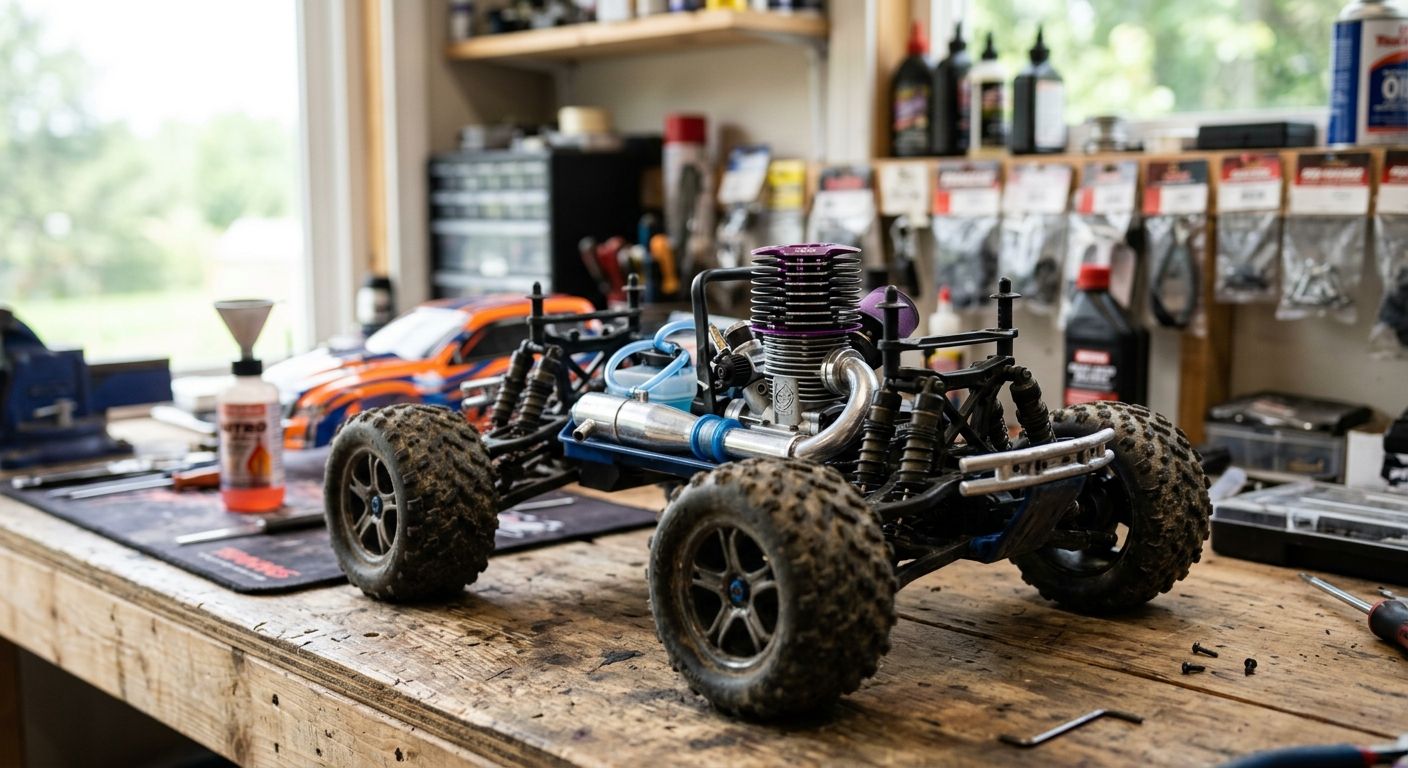
Picking a first nitro engine is where most beginners waste money — either on an engine too twitchy to break in cleanly, or one so underpowered it gets outgrown in a season. Best overall for a first nitro engine: Traxxas TRX 2.5. Best for beginners planning to race eventually: O.S. Engines 12TZ. Best budget option for a first buggy or truck: Force .21. Best for compact RTR platforms: HPI Nitro Star F3.5. Best for low-maintenance tuning: Dynamite .21 Type R. Five engines, five different beginner problems solved — match the pick to your vehicle and the mistake you're actually trying to avoid.
- Traxxas TRX 2.5 is the best nitro rc engine for beginners running factory RTR monster and stadium trucks in 2026.
- O.S. Engines 12TZ suits beginners who plan to race within a year or two — better parts support long-term.
- Force .21 is the budget pick for a first buggy build without spending on a premium powerband.
- HPI Nitro Star F3.5 fits compact RTR chassis where a smaller displacement engine matches the weight class.
- Dynamite .21 Type R trades peak output for the easiest glow plug access and simplest needle tuning.
Why this matters
A nitro engine doesn't fail because the beginner is bad at RC cars. It fails because the break-in period got rushed, the needle was set lean too early, or the glow plug heat range didn't match the fuel's nitro content. Piston-to-sleeve mating happens in the first few tanks of fuel, and how forgiving that window is depends entirely on the engine, not the driver.
That's the lens for this list: which engines give a beginner the widest margin for error before compression behavior starts to suffer. Controlled load testing on a dyno shows this clearly — some engines hold a stable powerband through a sloppy break-in, others don't. If you want that kind of verification on an engine you already own, nitro engine tuning and break-in service covers exactly that.
What makes the best nitro RC engine for beginners
- Break-in tolerance — how much margin exists before piston-to-sleeve mating goes wrong from an over-rich or over-lean run
- Starting method — pull-start/EZ-Start compatibility versus a manual flywheel that punishes bad technique
- Glow plug accessibility — how easy the plug is to reach and how flexible the heat range options are
- Parts and rebuild availability — sleeves, pistons, and carb parts still stocked years after purchase
- Displacement match — a .15 in a truck built for a .21 runs hot; oversized or undersized both cause problems
- Carburetor simplicity — a single high/low needle setup versus a multi-adjustment race carb
Nitro engines for beginners at a glance
| Engine | Best for | Standout feature | Key limitation |
|---|---|---|---|
| Traxxas TRX 2.5 | RTR monster/stadium trucks | EZ-Start pull-cord compatibility | Ceiling for serious racing is low |
| O.S. Engines 12TZ | Growing into racing | ABC construction, strong parts backing | Steeper break-in learning curve |
| Force .21 | Budget first buggy/truck | Straightforward carb, wide OEM fitment | Shorter service life before a rebuild |
| HPI Nitro Star F3.5 | Compact RTR chassis | Displacement matched to lighter cars | Underpowered if swapped into a heavier truck |
| Dynamite .21 Type R | Low-maintenance tuning | Easy glow plug access | Powerband is tame compared to race engines |
1. Traxxas TRX 2.5: best nitro RC engine for beginners running RTR trucks
The TRX 2.5 is the engine most beginners meet first because it ships stock in Traxxas nitro RTR trucks — a single-carb, pull-start setup built to survive inconsistent tuning. It's a .15 cu in class engine, small enough that a rich break-in doesn't punish the piston as hard as a bigger displacement would.
Traxxas TRX 2.5 pros:
- EZ-Start compatible, no manual flywheel required
- Single needle carb keeps tuning simple
- Widely available replacement parts through 2026
Traxxas TRX 2.5 cons:
- Displacement ceiling limits it against serious racing engines
- Powerband is flat compared to race-tuned .21s
Traxxas TRX 2.5 pricing: check current listings on the retailer or manufacturer site.
Best for: first-time owners of factory RTR monster or stadium trucks. Verdict: Buy.
2. O.S. Engines 12TZ: best nitro RC engine for beginners planning to race
O.S. Engines has decades of ABC (aluminum piston, brass sleeve, chrome-lined bore) construction behind the 12TZ, and that machining quality shows up as a more stable powerband once break-in is done correctly. It asks more of the beginner during the first few tanks, but rewards that patience with a tunable engine that still has headroom for club racing later in 2026 and beyond.
O.S. Engines 12TZ pros:
- ABC construction holds compression behavior longer
- Strong aftermarket parts and rebuild sleeve support
- Enough powerband headroom to race, not just cruise
O.S. Engines 12TZ cons:
- Break-in window is less forgiving than the TRX 2.5
- Manual flywheel start on most versions
O.S. Engines 12TZ pricing: varies by retailer; confirm current figures before buying.
Best for: beginners who expect to race within a year or two. Verdict: Buy.
3. Force .21: best budget nitro RC engine for a first buggy or truck
Force Engines built its reputation as the generic OEM replacement stocked across HPI, Redcat, and Team Losi RTR vehicles, and the .21 version is the one most beginners run into when a stock engine dies and they need a drop-in fix. It's not refined, but the carb is straightforward and fitment is broad.
Force .21 pros:
- Fits a wide range of RTR chassis without modification
- Simple carburetor, easy for a first tuning attempt
- Common enough that parts aren't hard to source
Force .21 cons:
- Shorter service life before needing a rebuild
- Powerband tapers earlier than the O.S. 12TZ or Nitro Star
Force .21 pricing: budget-tier; check listings for current cost.
Best for: a first nitro buggy or truck build without a premium price tag. Verdict: Buy.
4. HPI Nitro Star F3.5: best nitro RC engine for compact RTR platforms
The Nitro Star F3.5 was built for HPI's lighter chassis lines, and matching displacement to vehicle weight is one of the criteria above for a reason — an oversized engine in a light car runs hot and wears the sleeve faster than it should. On a compact platform, the F3.5's smaller displacement keeps compression behavior in a manageable range for a beginner still learning needle adjustment.
HPI Nitro Star F3.5 pros:
- Displacement matched to lighter RTR chassis
- Straightforward single-needle tuning
- Lower thermal load than an oversized swap
HPI Nitro Star F3.5 cons:
- Underpowered if moved into a heavier truck
- Parts availability narrower than Traxxas or O.S. lines
HPI Nitro Star F3.5 pricing: check current retailer listings.
Best for: beginners running compact RTR buggies or on-road cars stock. Verdict: Buy for the right chassis, skip for heavier trucks.
5. Dynamite .21 Type R: best nitro RC engine for low-maintenance tuning
Dynamite's .21 Type R won't win a powerband comparison against the O.S. 12TZ, but glow plug access is the easiest on this list, and the needle setup tolerates a wider range before it starts running rough. For a beginner who wants fewer variables while learning tuning basics, that tradeoff is worth it.
Dynamite .21 Type R pros:
- Easiest glow plug access on this list
- Wide tuning tolerance before performance drops
- Fits common Horizon Hobby-branded RTR vehicles
Dynamite .21 Type R cons:
- Tame powerband compared to race-oriented engines
- Not the pick if racing is the goal
Dynamite .21 Type R pricing: check current listings for 2026 pricing.
Best for: beginners who want tuning simplicity over peak output. Verdict: Buy.
How we ranked
Each engine was measured against the six criteria above — break-in tolerance, starting method, glow plug access, parts availability, displacement match, and carburetor simplicity — not against lap times. Compression behavior and powerband stability under a rushed break-in are what separate a beginner-friendly engine from one that punishes a first attempt, and that's the same data a controlled load test on a dyno reveals for an engine already sitting in your garage.
Get an engine verified before you race it
Dyno analysis and break-in service for a new or rebuilt nitro engine.
Which nitro RC engine should you choose?
If you're not sure, start with the Traxxas TRX 2.5 — it's the engine most beginner RTR trucks already ship with in 2026, the break-in tolerance is wide, and parts support isn't going anywhere. If you already know racing is the goal, spend the extra effort on the O.S. Engines 12TZ and get the break-in right the first time; that engine has the powerband headroom to actually grow with you. Budget-conscious buyers land on the Force .21, and anyone running a lighter chassis should check displacement against the HPI Nitro Star F3.5 before assuming bigger is better.
Vehicle type still matters more than the beginner label. If you're building specifically for an off-road buggy, the displacement and powerband priorities shift, and the same is true for an on-road touring car where corner-exit powerband matters more than low-end torque.
FAQ
What is the best nitro RC engine for beginners in 2026?
The Traxxas TRX 2.5 is the best overall pick for beginners in 2026 because of its wide break-in tolerance and pull-start compatibility. Beginners planning to race should look at the O.S. Engines 12TZ instead.
Is a bigger displacement nitro engine better for a beginner?
Not automatically — a .21 engine in a chassis built for a .15 runs hotter and wears the sleeve faster. Match displacement to the vehicle's weight class first, then worry about power.
How long does a nitro engine break-in take for a beginner?
Most manufacturers recommend a rich-mixture break-in across the first several tanks of fuel before running full RPM. Rushing this step is the single most common reason beginner engines lose compression early.
Is the O.S. Engines 12TZ better than the Traxxas TRX 2.5 for a first engine?
The 12TZ has more racing headroom and better long-term parts support, but the TRX 2.5's break-in is more forgiving for a true first attempt. Pick the 12TZ only if racing is the near-term plan.
Do budget nitro engines like the Force .21 wear out faster?
Yes, generally the Force .21 has a shorter service life before it needs a rebuild compared to the O.S. Engines 12TZ. It's still a reasonable choice for a first buggy or truck on a budget.
How much does a nitro RC engine rebuild cost?
Cost depends on whether it's a sleeve-and-piston replacement or a full rebuild with bearing service. A dedicated cost breakdown is worth reading before budgeting for your first rebuild.
What glow plug should a beginner use with a new nitro engine?
Match the plug heat range to the fuel's nitro content and the engine manufacturer's recommendation, not a generic default. A mismatched heat range is a common cause of rough idle and hard starting.
One last thing
The engine rarely fails on its own — the needle setting during break-in fails first, and the engine just shows the damage later. Beginners who log their needle position and glow plug choice for the first five tanks of fuel in 2026 have something a dyno session can actually compare against if the engine ever runs rough. That log is worth more than any spec sheet on this list.